


Visitor counter – this is how outdoor visitor measurement works
A visitor counter is used to measure how many people pass through a certain location. In outdoor environments, this could be at a hiking trail, the entrance to a nature reserve, a jogging track, a park or an outdoor recreation area.
By automatically counting passages, it is possible to get a clearer picture of how an area is actually used. The visitor statistics can then be used as a basis for everything from planning and maintenance to investments and follow-up of various initiatives.
For municipalities, county administrative boards, associations and other organizations, a visitor counter can therefore provide an answer to a seemingly simple but often difficult question: How many people actually use the area?
What is a visitor counter?
A visitor counter is a sensor or other technical solution that registers when people pass a specific measurement point. Unlike manual observations, an automatic visitor counter can measure continuously – around the clock and over longer periods of time. This makes it possible to not only see the total number of passages, but also to detect patterns over time.
For example, you can get answers to:
-
How many visits occur per day, week or month?
-
Which days of the week are most popular?
-
What times of the day are visitor numbers highest?
-
How does the number of visitors differ between different seasons?
-
Has an investment or action affected the number of visits?
The longer the measurement continues, the better the opportunity to understand how the area is used over time.
Where are visitor counters used?
Visitoor visitor counters are placed in places where you want to measure how many people pass by – for example in nature reserves, hiking trails, parks or outdoor areas. Counting visitors outdoors presents several challenges: weather conditions, varying mounting options and lack of electricity supply.
Therefore, Visitoors has been developed with these factors in mind. The device is:
-
Climate-resistant and weather-protected – designed to sit outside all year round in rain, snow and cold (IP67 rated).
-
Easy to assemble – quickly attaches to trees, poles or flat surfaces with the included screws and straps.
-
Self-sufficient – powered by a built-in lithium battery with up to 3 years of battery life.
Thanks to a narrow sensor beam and a range of up to 6 meters, the counter can distinguish between people walking closely together, providing high reliability.
The meter is connected via NB-IoT, a very low-power mobile technology in Telia's network, which ensures stable communication even in remote locations. Measurement data is automatically sent to a European cloud database every hour. Only the location of the device and the number of people passing by are stored there - no personal data is recorded or saved, making the system completely anonymous and GDPR-safe.


Why measure the number of visitors?
Many decisions about outdoor recreation and natural areas are made based on estimates. You know that an area is used, but not always how much, when or where. With actual visitor statistics, it becomes easier to make decisions based on data.
Planning
Operation and maintenance
If certain trails or areas are used significantly more than others, maintenance and other resources can be prioritized where the need is greatest.
Investments
Visitor data can serve as a basis for decisions regarding investments in, for example, trails, parking lots, rest areas, lighting or other infrastructure.
Follow-up
By measuring before and after an action, it is possible to see whether it has actually affected how the area is used.
Nature conservation
Knowledge of where many people move can also help with planning to reduce the burden on sensitive environments.
By understanding when and where people are in the area, resources and future actions can be better planned.
How does a visitor counter work?
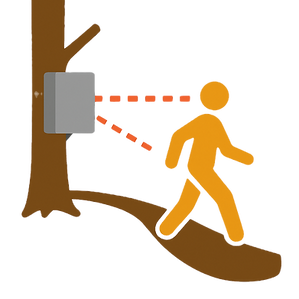
There are different technical methods for counting people. Depending on the environment and application, a visitor counter can, for example, use infrared sensors, camera technology or other types of sensors to detect a passage. However, the principle is often the same:
A person passes → the sensor registers the passage → the measurement is saved → the information is compiled into visitor statistics.
Visitor counting is used both indoors and outdoors. Indoors, it is often used in stores, shopping centers and museums where you want to know the number of visitors. Outdoors, it can be used to measure flows on walkways, at stations, in parks or in natural areas.
Outdoor visitor counting places special demands on the equipment. The counter needs to be able to function for long periods and withstand, for example, rain, snow, cold and varying temperatures. In locations far from buildings, access to electricity and the internet may also be limited. Therefore, low energy consumption, battery operation and wireless communication are important features of visitor counters that are to be used in nature.
What should you consider when choosing a visitor counter?
There are several things to consider before choosing a system.
The environment
Should the calculator be placed indoors or outdoors? For outdoor use, the equipment needs to withstand weather, moisture and large temperature differences.
Power supply
Is there electricity on site or does the calculator need to be able to operate on battery power for an extended period of time?
Communication
How will the measurement data be retrieved? Does someone need to visit the meter or can the information be transferred automatically?
Installation
A measurement point can be located far out in nature. Therefore, simple mounting on, for example, trees, poles or other existing structures can be an advantage.
Visitoor visitor counters are placed in places where you want to measure how many people pass by – for example in nature reserves, hiking trails, parks or outdoor areas. Counting visitors outdoors presents several challenges: weather conditions, varying mounting options and lack of electricity supply.
Therefore, Visitoors has been developed with these factors in mind. The device is:
-
Climate-resistant and weather-protected – designed to sit outside all year round in rain, snow and cold (IP67 rated).
-
Easy to assemble – quickly attaches to trees, poles or flat surfaces with the included screws and straps.
-
Self-sufficient – powered by a built-in lithium battery with up to 3 years of battery life.
Thanks to a narrow sensor beam and a range of up to 6 meters, the counter can distinguish between people walking closely together, providing high reliability.
The meter is connected via NB-IoT, a very low-power mobile technology in Telia's network, which ensures stable communication even in remote locations. Measurement data is automatically sent to a European cloud database every hour. Only the location of the device and the number of people passing by are stored there - no personal data is recorded or saved, making the system completely anonymous and GDPR-safe.
Collecting data is just the first step. The information also needs to be easy to understand and use.
Integrity
It is important to understand what information the system collects and whether personal data is processed.
Visitor counter and personal privacy
Visitoor visitor counters are placed in places where you want to measure how many people pass by – for example in nature reserves, hiking trails, parks or outdoor areas. Counting visitors outdoors presents several challenges: weather conditions, varying mounting options and lack of electricity supply.
Therefore, Visitoors has been developed with these factors in mind. The device is:
-
Climate-resistant and weather-protected – designed to sit outside all year round in rain, snow and cold (IP67 rated).
-
Easy to assemble – quickly attaches to trees, poles or flat surfaces with the included screws and straps.
-
Self-sufficient – powered by a built-in lithium battery with up to 3 years of battery life.
Thanks to a narrow sensor beam and a range of up to 6 meters, the counter can distinguish between people walking closely together, providing high reliability.
The meter is connected via NB-IoT, a very low-power mobile technology in Telia's network, which ensures stable communication even in remote locations. Measurement data is automatically sent to a European cloud database every hour. Only the location of the device and the number of people passing by are stored there - no personal data is recorded or saved, making the system completely anonymous and GDPR-safe.
From visitor counters to useful statistics
A single number doesn't always tell you much. The real value comes when measurements over time can be analyzed and compared. With continuous visitor measurement, for example, you can discover that an area:
-
used significantly more on weekends than weekdays
-
has the highest visitor pressure during certain times of the day
-
received more visitors after a new investment
-
has large seasonal variations
-
have certain trails or entrances that are used more than others
The visitor counter thus becomes a tool for creating a better basis for decision-making .
Better knowledge about how our outdoor areas are used
Outdoor areas, trails, parks and nature reserves create great value for both people and society. At the same time, it can be difficult to show how much these places are actually used. A visitor counter makes it possible to replace estimates with measured data. For organizations responsible for our shared outdoor environments, this knowledge can contribute to better planning, clearer follow-up and more informed decisions.
Want to know more about how Visitoor's visitor counter works? Read more about our visitor counter and how collected visitor data is converted into useful statistics in the analysis tool .